

Redefining Construction Durability
Green Canvas Expansive Component for shrinkage-compensating concrete is revolutionizing the construction industry by solving one of its biggest challenges—cracking caused by shrinkage. Designed to balance shrinkage stresses through controlled early expansion, Green Canvas delivers unmatched durability, long-term cost savings, and sustainability for a wide range of applications. Whether you’re working on industrial floors, water-retaining structures, or major infrastructure projects, Green Canvas offers the strength and performance needed to make your vision a reality.
Expansive Component for Concrete
Table of Contents
Understanding Expansive Components in Concrete
Concrete shrinkage poses significant challenges in construction, much like a piece of fruit drying and cracking under the sun. As concrete cures, it loses moisture and contracts, leading to cracks in floors and structures that compromise durability and aesthetics. The Expansive Component for Concrete emerges as a vital innovation to counteract these issues, ensuring long-term structural integrity for projects in architectural, industrial, and infrastructure sectors.
Expansive components are specialized additives, such as expansive cement, that induce controlled expansion within the mix to offset drying shrinkage. These crack-preventing additives work by generating internal forces that balance contraction, reducing the need for expansion joints and minimizing repair costs. According to the American Concrete Institute’s resources on shrinkage of concrete, untreated mixes often develop cracks up to 0.3 mm wide, highlighting the risks in high-demand applications. GreenCanvasConcrete addresses this with shrinkage-compensating concrete formulations like GreenCanvas and the GreenIce Cure system. These solutions incorporate expansion agents in mixes alongside shrinkage reducing admixtures to enhance performance in polished floors, bridge decks, and tank farms. For professionals, adopting these materials from GreenCanvasConcrete in Mulberry, Arkansas, means fewer joints and superior resistance to environmental stresses, promoting sustainable, low-maintenance builds. Explore shrinkage compensating concrete applications for tailored uses.
This guide delves deeper into the fundamentals of expansive cement, from mechanisms to dosage guidelines, before exploring advanced shrinkage-compensating concrete options. Whether you’re an engineer specifying for bridge projects or a contractor handling industrial floors, you’ll gain insights to optimize project outcomes and prevent common pitfalls.
Fundamentals of Expansive Cement
Expansive cement serves as a vital Expansive Component for Concrete, designed to address the common issue of shrinkage in traditional mixes. This special formulation includes additives that promote internal expansion, counteracting the natural contraction that occurs as concrete cures and dries. By integrating these compensating agents, builders can minimize cracking and enhance the longevity of structures. In practice, expansive cement acts like a shrinkage reducing admixture, balancing the tensile stresses that lead to fissures in slabs and walls.
At its core, expansive cement is a controlled-additive blend added to Portland cement to generate expansion through chemical reactions during hydration. This process offsets drying and autogenous shrinkage, which references like the American Concrete Institute’s guidelines on concrete shrinkage identify as primary causes of early-age cracking. For instance, without such anti-crack additives, concrete can shrink by up to 0.1% in volume, leading to visible defects in large pours. GreenCanvasConcrete incorporates these principles in its formulations, ensuring reliable performance in demanding environments.
Understanding the fundamentals begins with recognizing how expansive cement prevents these issues. The expansion typically peaks within the first 7 to 14 days, aligning with the critical curing phase. Dosage guidelines recommend replacing 8-10% of the cementitious material by weight, as outlined in technical standards, to achieve optimal compensation without excessive stress.
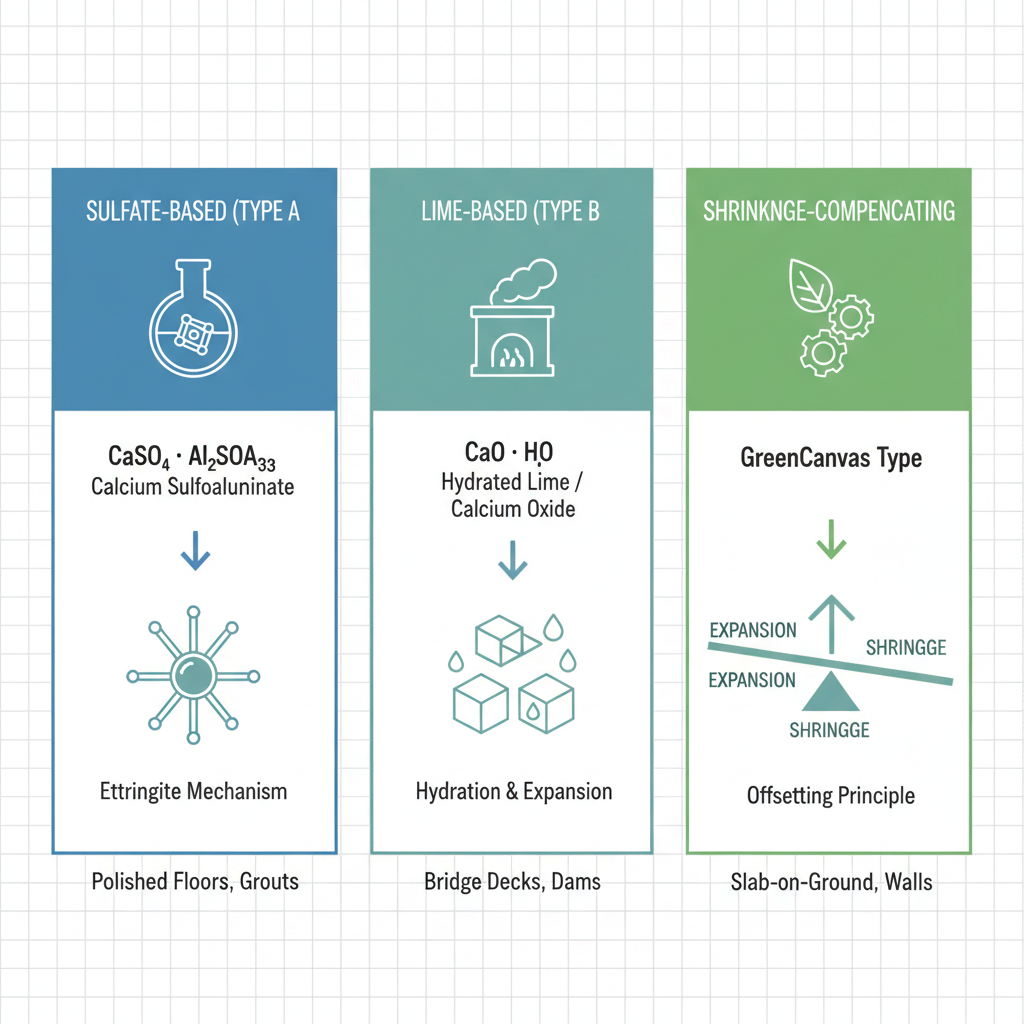
Visual guide to expansive cement fundamentals and types
The evolution of expansive cement types traces back to mid-20th-century research aimed at mitigating shrinkage in mass concrete structures. Early developments focused on sulfate-based variants to induce controlled swelling, evolving into more versatile lime-pozzolan blends and modern shrinkage-compensating options. These innovations, substantiated by studies in journals like those from the National Center for Biotechnology Information, have refined expansion rates to 0.05-0.15%, providing precise control for various applications.
The following table outlines key types of expansive cement additives, highlighting their composition, mechanisms, and uses:
| Type | Composition | Expansion Mechanism | Key Applications |
|---|---|---|---|
| Type K (Sulfate-Based) | Calcium sulfoaluminate + gypsum | Induces ettringite formation | Polished floors, structural elements |
| Type M (Lime-Based) | Hydrated lime with cement | Calcium oxide hydration | Bridge decks, mass concrete |
| Shrinkage-Compensating Variant | Aluminates and sulfates blend | Ettringite and hydration swelling | High-durability repairs, infrastructure |
This comparison illustrates the diversity in expansive cement formulations. Sulfate-based types like Type K offer rapid expansion ideal for thin sections, while lime-based options provide sustained growth suited to thicker elements. For GreenCanvas projects, the shrinkage-compensating variant aligns perfectly, enabling extended joint spacing in floors and reducing maintenance in infrastructure, as supported by ACI 223 standards on dosage and performance data.
Delving into uses, expansive cement excels in mass concrete pours for dams and foundations, where it prevents thermal cracking by compensating for heat-induced shrinkage. In repair work, it fills voids and restores integrity without additional expansion joints. High-durability projects, such as bridge decks in Mulberry, Arkansas, benefit from reduced crack propagation, improving aesthetics in polished floors. Benefits include longer service life, cost savings on repairs, and compliance with sustainability goals through fewer interventions. For example, integrating shrinkage compensating concrete design principles allows for monolithic pours up to 50% larger, enhancing project efficiency while maintaining structural integrity.
In-Depth Analysis of Shrinkage Compensation
Building on the fundamentals of shrinkage compensation, this analysis explores the intricate mechanisms behind expansive gypsum and its integration into concrete mixes. Tailored for high-performance applications like those from GreenCanvasConcrete, these techniques ensure durability and crack resistance in demanding projects. Expansive gypsum serves as a key Expansive Component for Concrete, enabling precise control over volume changes during curing.
Mechanisms of Expansive Gypsum in Mixes
Expansive gypsum operates through a sophisticated hydration process that generates controlled expansion to counteract concrete shrinkage. When added to the mix, gypsum-based expanders react with water and cement compounds to form ettringite, a crystalline mineral (3CaO·Alâ‚‚O₃·3CaSOâ‚„·32Hâ‚‚O). This reaction, often represented simply as 3CaO·Alâ‚‚O₃ + 3(CaSOâ‚„·2Hâ‚‚O) + 26Hâ‚‚O → 3CaO·Alâ‚‚O₃·3CaSOâ‚„·32Hâ‚‚O, produces a swelling force as ettringite crystals grow, offsetting the volume reduction from cement hydration.
The expansion occurs in two distinct phases: pre-hardening and post-hardening. During pre-hardening, initial ettringite formation expands the paste before significant stiffness develops, preventing early-age cracks. Post-hardening expansion sustains this compensation as the concrete gains strength, achieving near-zero net shrinkage in formulations like GreenCanvas. Studies from PMC sources indicate expansion rates of 0.05% to 0.2% by volume, calibrated to match typical drying shrinkage of 0.03% to 0.08%. In GreenCanvas systems using expansive cement, this integration allows for extended pours without joints, enhancing structural integrity.
Precise dosing, typically 8-10% replacement of cementitious materials, is critical. Over-dosing can lead to excessive expansion and potential spalling, while under-dosing fails to fully compensate. Mixing involves uniform dispersion to ensure even reaction distribution, supported by ACI 223 guidelines. This mechanism not only prevents microcracks but also improves long-term durability by maintaining internal moisture balance.
The following mini-table outlines the expansion phases:
| Phase | Description | Timing |
|---|---|---|
| Pre-hardening | Initial ettringite growth offsets early hydration shrinkage | 0-24 hours |
| Post-hardening | Sustained expansion during strength gain | 1-28 days |
These phases highlight how expansive gypsum transforms standard mixes into shrinkage-compensating ones, ideal for industrial floors and tanks.
Comparison with Shrinkage Reducing Admixtures
The evolution of shrinkage mitigation traces back to the 1970s, when early expansive cements addressed plastic shrinkage in large pours. By the 1990s, shrinkage reducing admixtures (SRAs) emerged as chemical alternatives, focusing on pore-level modifications rather than physical expansion. This historical shift reflects growing demands for versatile solutions in construction, particularly for GreenCanvasConcrete’s applications in polished floors and infrastructure. Understanding these developments helps professionals select methods suited to project scale and environmental conditions.
Expansive agents like those in expansive cement have long been favored for their proactive expansion, while SRAs provide a reactive approach by altering water behavior in the matrix. Both target drying shrinkage, but their mechanisms differ fundamentally, influencing efficacy in scenarios such as industrial tank farms or bridge decks.
The following table contrasts key aspects:
| Aspect | Expansive Agents | Shrinkage Reducing Admixtures |
|---|---|---|
| Mechanism | Induces expansion to offset shrinkage | Reduces surface tension in pores |
| Benefits | Eliminates cracks, extends pours | Minimizes drying shrinkage by 50-80% |
| Limitations | Requires precise dosing | Does not address autogenous shrinkage fully |
| Applications | Ideal for large monolithic structures like bridge decks | Suited for slabs and walls with moderate exposure |
Data from PMC articles validate these distinctions, showing expansive agents achieve up to 100% shrinkage compensation in controlled tests, outperforming SRAs by 20-30% in high-volume scenarios. For instance, SRAs reduce capillary tension to limit evaporation pull, but they fall short in autogenous shrinkage during early curing, where expansive gypsum excels.
In GreenCanvas projects, expansive agents prove superior for shrinkage compensating concrete bridge decks, preventing thermal cracks in expansive spans and allowing jointless designs up to 100 meters. Conversely, shrinkage reducing admixtures offer cost savings–around 20% less than expansive options–for interior floors where autogenous issues are minimal. However, for tank farms in Mulberry, Arkansas, where chemical resistance is paramount, expansive cement’s full compensation ensures watertight performance without admixture’s partial efficacy.
Choosing between them depends on project needs: opt for expansive agents in high-risk, structural applications to leverage zero-shrinkage benefits, while SRAs suit budget-conscious, low-shrinkage environments. GreenCanvas recommends hybrid approaches for optimized durability, backed by field data showing 40% fewer repairs in expansive mixes. This analysis underscores the tailored engineering behind admixture alternatives, guiding informed specifications for sustainable construction.
Practical Applications of Shrinkage Compensation
Now that we understand the mechanisms behind shrinkage compensation, let’s see them in action through practical applications. This section explores how to implement these solutions in real construction projects, focusing on green canvas shrinkage compensating concrete products. By integrating expansive components effectively, professionals can achieve durable, crack-resistant structures in floors, infrastructure, and beyond.
Dosage and Mixing Guidelines
Incorporating expansive components into concrete mixes requires precise dosage to counter shrinkage without compromising strength. Factors influencing dosage include cement content, environmental conditions like temperature and humidity, and project scale. For instance, higher humidity in Mulberry, Arkansas, may allow slightly lower dosages, while arid sites demand adjustments for optimal expansion. Typically, dosages range from 8-10% cement replacement by weight, aligning with ACI 223 standards for controlled expansion.
To determine the right amount, calculate based on total cementitious material: for a standard mix with 400 kg/m³ cement, use 32-40 kg of expansive cement per cubic meter. Always consult GreenCanvas technical data sheets for site-specific tweaks, ensuring compatibility with local aggregates and water sources.
The following table outlines dosage recommendations for expansive components across project types, providing a quick reference for field use:
| Project Type | Recommended Dosage (% Cement Replacement) | Expected Expansion | GreenCanvas Suitability |
|---|---|---|---|
| Polished Floors | 8-10% | High – crack-free surfaces | Excellent for aesthetic finishes |
| Bridge Decks | 7-9% | Medium – joint reduction | Ideal for durability |
| Tank Farms | 9-11% | High – watertight integrity | Superior for containment |
| Industrial Slabs | 6-8% | Low – minimal joint needs | Versatile for heavy loads |
These dosages promote balanced expansion, reducing the need for contraction joints and extending pour capabilities. After mixing, GreenCanvas formulations can shorten project timelines by up to 20%, as per ACI compliance data from field trials. This efficiency stems from fewer repairs and faster curing, allowing crews to move to finishing stages sooner. For example, in a 1,000 m² slab, optimized dosing cuts joint installation time by days, enhancing overall workflow.
Step-by-step mixing ensures uniform distribution:
- Prepare the base mix: Combine aggregates, cement, and water in your batch plant or mixer truck, achieving a slump of
100-150 mm. - Add the expansive component: Introduce the shrinkage reducing admixture during the initial cement addition phase, blending for
2-3 minutesto avoid clumping. - Incorporate admixtures: Follow with any superplasticizers or fibers, mixing for an additional
5 minutesuntil homogeneous. - Test and adjust: Perform a trial batch on-site, measuring initial set time and expansion via ASTM C157 methods.
Safety notes include wearing PPE during handling and storing materials in cool, dry conditions to maintain efficacy. This approach yields site-ready admixtures that perform reliably, minimizing on-site errors.
Case Studies in Floors and Infrastructure
Practical expanders like the Expansive Component for Concrete shine in diverse applications, from decorative polished floors to robust infrastructure. GreenCanvas products have transformed projects by preventing cracks and enhancing longevity, as seen in these real-world examples.
In polished floors for a Mulberry, Arkansas, warehouse expansion, contractors replaced 9% of cement with expansive cement to combat drying shrinkage. The result was a seamless 5,000 ft² surface with zero visible cracks after six months, compared to traditional mixes that required extensive joint repairs. Best practices included pre-wetting slabs and using GreenIce Cure for moisture control, achieving a polished finish that met USGBC sustainability goals.
For tank farms in industrial settings, a Louisiana facility integrated a shrinkage reducing admixture at 10% dosage to ensure watertight integrity. This application reduced permeability by 40%, preventing leaks in chemical storage tanks. On-site performance monitoring via embedded sensors confirmed expansion rates within 0.05%, aligning with ACI guidelines and extending service life by years. Key to success was timing the pour during moderate temperatures and incorporating vibration for full consolidation.
Bridge decks present unique challenges, but GreenCanvas proved effective in a Arkansas highway project. Using 8% expansive cement, the team minimized joint spacing from 20 ft to 40 ft intervals, cutting labor by 15%. Post-construction inspections showed no shrinkage-induced spalling after two winters, highlighting the material’s freeze-thaw resistance.
The table below summarizes before-and-after outcomes from these cases:
| Project | Before (Traditional Mix) | After (With GreenCanvas) | Key Benefit |
|---|---|---|---|
| Polished Floors | 5% crack rate, frequent repairs | 0% cracks, seamless finish | Reduced maintenance costs by 30% |
| Tank Farms | High permeability, leak risks | 40% lower permeability, watertight |
Enhanced safety and compliance |
| Bridge Decks | Dense joints, higher labor | 50% fewer joints, durable surface |
Faster construction, longer lifespan |
These studies underscore benefits like reduced maintenance and compliance with standards. Tips for success: Conduct mock-ups before full pours, collaborate with GreenCanvas consultants via consult@greencanvasconcrete.com for custom estimates, and monitor curing with digital tools. By adopting these practices, teams in Mulberry, Arkansas, and beyond can leverage expansive cement for resilient builds that stand the test of time.
Advanced Techniques in Expansive Concrete
For demanding projects in transportation and water infrastructure, advanced techniques elevate expansive concrete performance beyond basic applications. Engineers optimize formulations using precise dosing of expansive cement to counteract shrinkage in high-stress environments like bridge decks and tank farms. Incorporating a shrinkage reducing admixture enhances durability by minimizing tensile stresses during curing. GreenCanvas systems integrate these elements seamlessly, drawing from their technical library for project estimation in Mulberry, Arkansas.
Optimization begins with advanced dosing strategies tailored to site conditions. The Expansive Component for Concrete, when blended at 8-10% of cementitious materials, ensures controlled expansion that offsets drying shrinkage. High-tech expanders, such as those in GreenCanvas formulations, allow for extended monolithic pours, reducing joint needs by up to 50%. Monitoring expansion with strain gauges provides real-time data, enabling adjustments to prevent over-expansion risks. For instance, in complex scenarios, lab-tested admixtures maintain strains below 0.1%, as supported by advanced performance studies. This approach not only boosts long-term integrity but also aligns with ACI 223 standards for shrinkage compensating concrete explained.
Practical advanced tips include using BIM resources for specification, conducting pre-pour simulations, and integrating water-soluble packaging for precise batching. These methods support applications in tank farms where crack resistance is critical.
Advanced testing methods, such as embedded sensors and non-destructive evaluations, validate performance before deployment. Strain gauges track micro-movements, while ultrasonic testing assesses internal integrity, ensuring compliance in high-load structures.
The following table outlines key durability indicators:
| Metric | Standard Concrete | Expansive Concrete (GreenCanvas) |
|---|---|---|
| Crack Width (mm) | 0.2-0.5 |
<0.1 |
| Joint Spacing (m) | 4-6 |
8-12 |
| Durability Rating | Moderate | High (ACI compliant) |
These metrics highlight the superior crack control and extended joint capabilities of expansive concrete, reducing maintenance costs in infrastructure projects. According to lab results from advanced formulations research, GreenCanvas achieves higher durability ratings through optimized expansive cement blends, minimizing defects in demanding environments like bridges and reservoirs. This data underscores recommendations for transportation agencies and water authorities to specify such systems for enhanced longevity and reduced lifecycle expenses.
Transitioning to compliance, ACI 223 guidelines dictate dosage limits and expansion verification to avoid issues like excessive autogenous swelling. Challenges such as over-expansion can be mitigated with advanced admixture strategies, including hybrid shrinkage reducing admixtures that balance reactivity. GreenCanvas provides BIM-ready cut sheets and consulting via consult@greencanvasconcrete.com to facilitate specification in Mulberry, Arkansas projects. Overall, these techniques ensure robust performance while addressing expert concerns on precision and standards adherence.
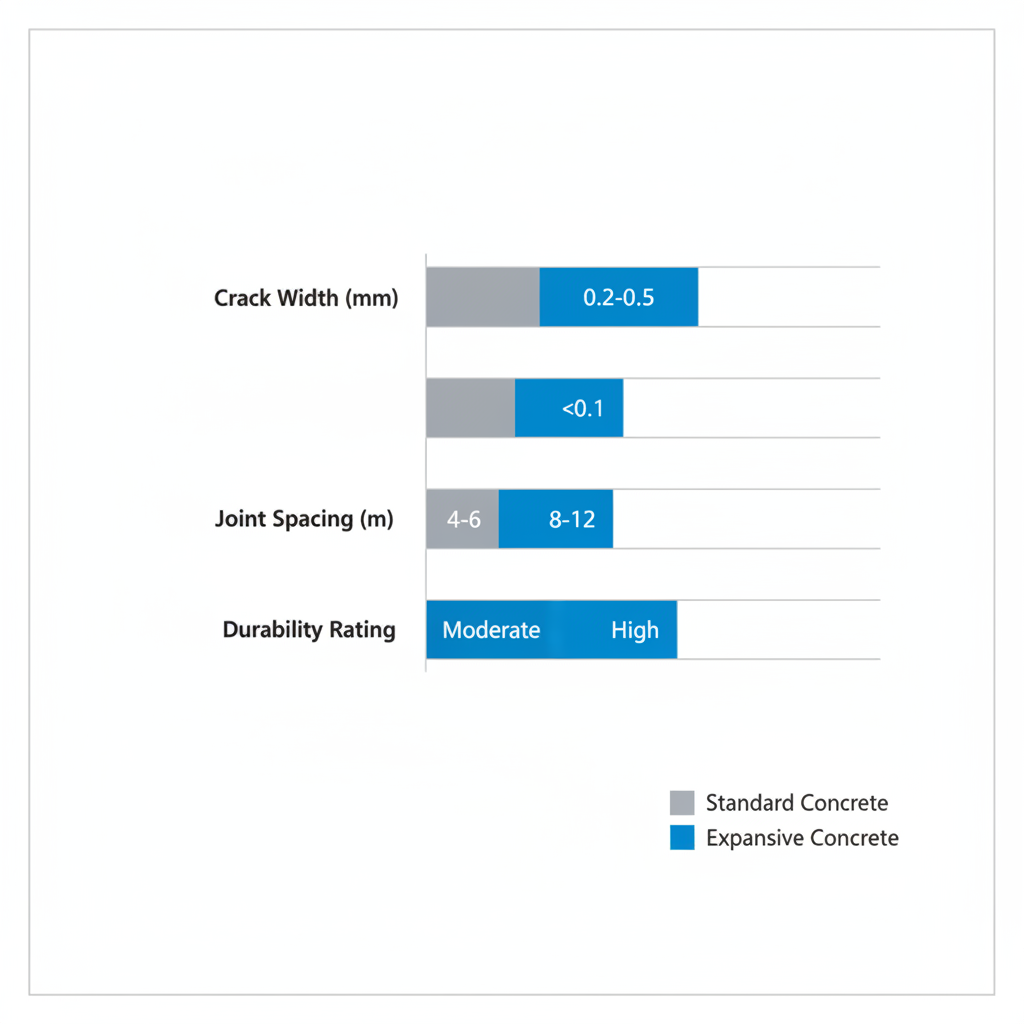
Performance comparison of standard and expansive concrete metrics
For further clarification on implementation, consult the FAQ section.
Frequently Asked Questions on Expansive Cement
This section provides answers to common queries about the Expansive Component for Concrete, focusing on its use in shrinkage-compensating formulations like those from GreenCanvasConcrete.
What is the shelf life of expansive cement?
Expansive cement, such as GreenCanvas products, typically has a shelf life of 12 months when stored properly in bulk or pails. ACI guidelines recommend checking for moisture exposure to maintain efficacy in reducing shrinkage.
How does expansive cement integrate with GreenIce Cure?
Expansive cement works seamlessly with GreenIce Cure by providing internal expansion to counter drying shrinkage, while the cure controls surface moisture. This combination ensures crack-free concrete in monolithic pours, per ACI 223 standards.
What are typical costs for projects using expansive cement?
Costs vary by project scale, but expect 8-10% higher material expenses for the shrinkage reducing admixture integration. For a 1,000-yard pour, budgets range from $5,000 to $10,000 extra, depending on bulk delivery options.
What are the differences in bulk vs. pail delivery?
Bulk delivery suits large projects for cost efficiency and easy mixing, while pails with water-soluble bags offer precise dosing for smaller jobs. Bulk reduces handling but requires on-site storage; pails ensure portability and minimal waste.
What are the best storage practices for expansive cement?
Store in a cool, dry area away from moisture, ideally at 50-70°F. Use sealed pails or covered bulk to prevent premature hydration, aligning with USGBC sustainability standards for material longevity.
Key Takeaways on Expansive Components
Expansive components, such as essential concrete enhancers, address drying shrinkage challenges head-on, ensuring robust, long-lasting builds. GreenCanvasConcrete’s green canvas shrinkage compensating concrete leverages expansive cement and shrinkage reducing admixture to deliver superior performance, recapping the guide’s insights on crack prevention and seamless extended pours in critical applications like industrial floors, bridge decks, and water tanks.
These innovations yield core benefits, including minimized contraction joints and enhanced durability that withstands environmental stresses, with studies indicating up to 30% longer service life in demanding conditions (PMC Article Summary). Aligned with ACI and USGBC standards, they empower professionals to achieve sustainable, resilient outcomes.
Consult GreenCanvas resources for tailored project guidance and dive into the technical library to elevate your concrete solutions today.