

Redefining Construction Durability
Green Canvas Expansive Component for shrinkage-compensating concrete is revolutionizing the construction industry by solving one of its biggest challenges—cracking caused by shrinkage. Designed to balance shrinkage stresses through controlled early expansion, Green Canvas delivers unmatched durability, long-term cost savings, and sustainability for a wide range of applications. Whether you’re working on industrial floors, water-retaining structures, or major infrastructure projects, Green Canvas offers the strength and performance needed to make your vision a reality.
Reduce Concrete Shrinkage Cracks
Table of Contents
The Impact of Shrinkage Cracks on Concrete Projects
Concrete shrinkage cracks pose a significant challenge in construction, compromising both structural integrity and aesthetic appeal in projects like industrial floors and slabs. These fissures, often appearing shortly after pouring, can lead to water infiltration, corrosion of reinforcements, and costly repairs. According to industry data, up to 80% of cracks in concrete slabs stem from shrinkage-related issues, underscoring the need for strategies to reduce concrete shrinkage cracks. Engineers and contractors frequently encounter these problems, which disrupt timelines and inflate budgets.
Shrinkage cracks arise primarily from drying shrinkage, where moisture loss causes the concrete to contract, and chemical shrinkage during hydration. External restraints, such as adjacent structures or improper formwork, exacerbate these tensions, leading to uncontrolled cracking in pours. To minimize drying shrinkage issues, traditional methods like control joints allow planned separation points for expansion. However, innovative approaches, such as shrinkage compensating concrete, offer proactive concrete crack prevention by counteracting volume changes, aligning with ACI standards for durable results in floors, slabs, and infrastructure.
This guide explores the mechanics of shrinkage, benefits of compensating admixtures, application best practices, and more, empowering specifiers to achieve low-crack concrete applications effectively.
Causes and Mechanisms of Concrete Shrinkage
Concrete shrinkage represents a critical challenge in construction, particularly for slabs and floors where uncontrolled volume changes lead to unsightly and structurally compromising cracks. This section explores the primary causes, including drying and chemical processes, alongside restraint factors that amplify these issues. By understanding these mechanisms, professionals can implement targeted strategies to maintain durability in industrial and architectural projects.
Drying Shrinkage and Its Effects
Drying shrinkage occurs as concrete loses moisture to the surrounding environment, primarily through evaporation from the surface and internal pores. This process begins shortly after placement and curing, with water migrating outward driven by capillary tension, resulting in a gradual reduction in volume. As the concrete hardens, this moisture loss creates tensile stresses that exceed the material’s low tensile strength, often leading to random cracking within hours to days, depending on environmental conditions like low humidity and high temperatures.
The effects manifest as fine surface cracks that can propagate deeper if unchecked, compromising aesthetics and watertightness in applications such as polished floors. To manage drying contraction, early interventions focus on maintaining surface moisture during the initial curing phase. Strategies to reduce concrete shrinkage cracks include optimizing mix designs with lower water-cement ratios and incorporating admixtures that help mitigate volume change issues. According to ACI insights from cracking studies, this mechanism accounts for a significant portion of early-age distress in flatwork.
Key factors in drying shrinkage:
- Evaporation rate influenced by wind and temperature
- Pore structure determining moisture escape paths
- Timeline of crack formation, typically visible within 24-48 hours
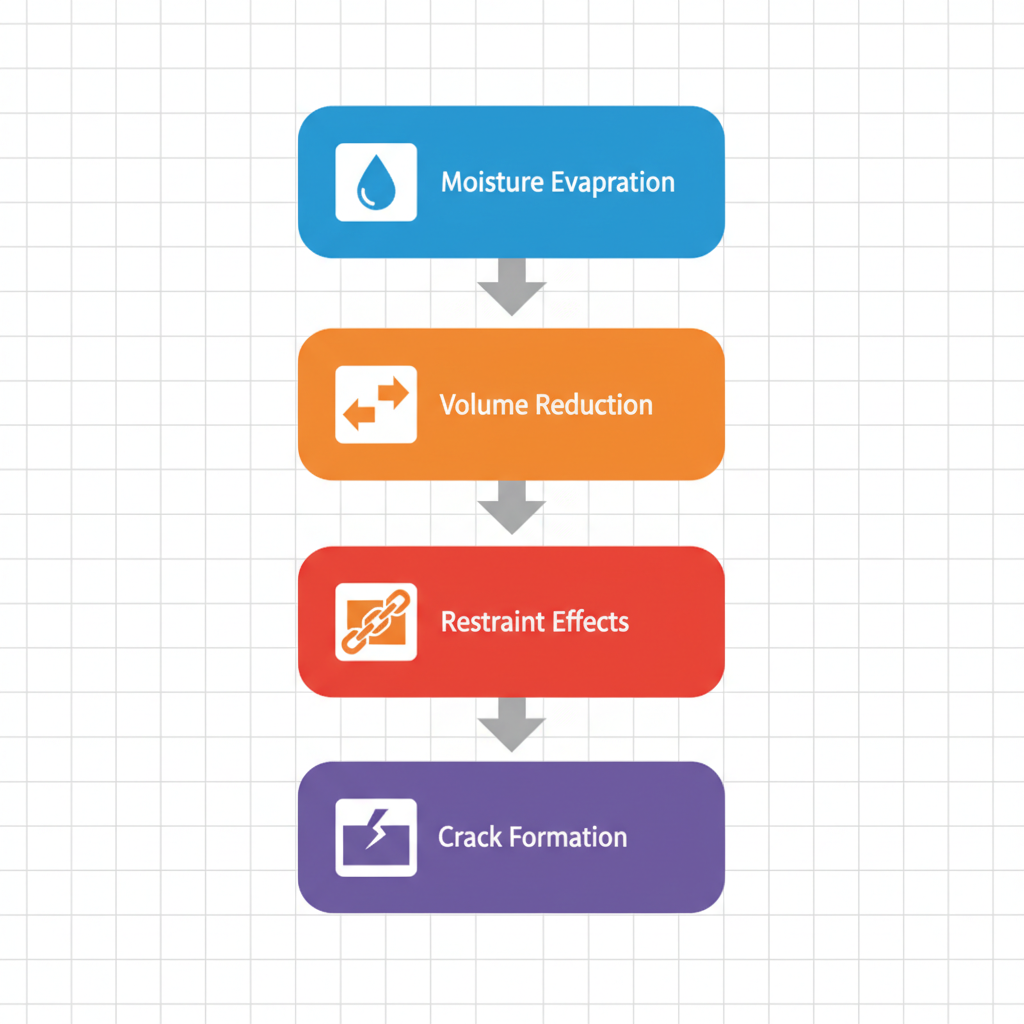
Illustrated process of concrete shrinkage causes and stages
This diagram highlights how initial hydration interacts with environmental drying to initiate stress buildup, providing a visual aid for diagnosing on-site issues.
Restraint to Shrinkage in Construction
Restraint to shrinkage is the most common trigger for cracking, occurring when the contracting concrete is held back by external or internal forces, preventing free dimensional change. External restraints include subgrade friction, where the base material resists sliding, with friction coefficients around 0.5-0.7 for typical soils generating substantial tensile forces in large pours. Internal restraints arise from reinforcement bars or embedded elements that bond to the concrete, creating differential movement as the matrix shrinks unevenly.
In slab pours, these restraints are evident in edge lifting or full-depth cracks forming perpendicular to the restrained direction, especially in monolithic placements exceeding 20 feet. ACI data emphasizes that restraint amplifies drying and autogenous shrinkage, contributing to up to 80% of observed cracks in restrained elements. Chemical shrinkage from ongoing hydration reactions further compounds this, as the products occupy less volume than the reactants, adding internal stress without external moisture loss.
Examples from industrial floors show how subbase preparation can reduce friction, while proper reinforcement spacing limits internal pull. Autogenous shrinkage, prominent in high-performance mixes, underscores the need for balanced design to avoid premature distress.
Role of Control Joints in Crack Management
Control joints serve as deliberate weak points in concrete to predetermine and manage crack locations, directing shrinkage-induced stresses to controlled paths rather than random propagation. These saw-cut joints are typically installed after initial set, within 6-18 hours for most mixes, at depths of one-quarter to one-third the slab thickness to ensure full propagation under tensile load, per TxDOT and ACI guidelines.
The process involves marking joint layouts in a grid pattern spaced 2-3 times the slab depth for uniform stress distribution, then using early-entry saws to minimize spalling. This concrete crack prevention technique maintains structural appearance by confining cracks to narrow, predictable lines, reducing the need for repairs in architectural and transportation applications.
In practice, for a 6-inch slab, joints at 12-15 feet intervals with 1.5-2 inch depths allow shrinkage to accommodate without widespread failure. Limitations of joints, such as labor intensity and aesthetic interruptions, highlight the value of advanced options like shrinkage compensating concrete, which incorporates expansive concrete additives to offset contraction internally. ACI compliance ensures these joints integrate seamlessly with overall pavement design, promoting longevity in demanding environments.
Key joint design elements:
- Timing window to balance hardness and cut quality
- Depth ratios for effective stress relief
- Spacing guidelines tied to aggregate size and environmental factors
While effective, control joints represent a traditional approach; integrating expansive concrete additives offers proactive mitigation for extended pours without frequent interruptions.
Advantages of Using Shrinkage Compensating Solutions
Shrinkage compensating concrete offers significant advantages over standard mixes, particularly in demanding applications like floors, bridges, and tanks. By counteracting drying shrinkage, these solutions minimize cracking and enhance long-term performance, aligning with standards from the American Concrete Institute (ACI) and the U.S. Green Building Council (USGBC). This approach not only improves structural integrity but also supports sustainable construction practices through reduced material waste and extended service life.
Enhanced Durability for Slabs and Floors
Shrinkage compensating concrete significantly boosts the durability of slabs and floors by addressing the root cause of cracking: volume reduction during curing. Traditional mixes often require contraction joints every 15 to 20 feet to manage shrinkage stresses, but compensating admixtures like those in green canvas concrete enable longer monolithic pours, reducing joint needs by up to 50% according to Texas Department of Transportation (TxDOT) guidelines for rigid pavement design. This leads to smoother, more uniform surfaces ideal for polished floors in commercial spaces.
For industrial applications, such as tank farms, these solutions achieve crack-resistant slabs that withstand heavy loads without fracturing. To reduce concrete shrinkage cracks, the admixture expands slightly during hydration, optimizing shrinkage control and preventing random fissures that compromise aesthetics and functionality. ACI data indicates up to 50% fewer cracks compared to non-compensating mixes, extending the lifespan of floors in high-traffic areas. Additionally, integrally trowelable cures from GreenCanvas maintain surface moisture, further enhancing resistance to environmental stresses.
Real-world case studies, like large warehouse slabs, demonstrate how these benefits translate to fewer disruptions during operation. By minimizing joint-related vulnerabilities, specifiers can design larger, seamless areas that support architectural visions while ensuring compliance with durability standards.
Cost Savings in Construction Projects
Investing in shrinkage compensating concrete yields substantial cost savings over the project lifecycle, primarily through reduced maintenance and repair needs. Initial material costs may be 5-10% higher due to the admixture, but this is offset by eliminating frequent crack repairs, which can account for 20-30% of post-construction budgets in traditional setups. Fewer joints mean less labor for saw-cutting and sealing, streamlining installation and lowering immediate expenses.
Long-term return on investment (ROI) shines in scenarios like bridge decks or industrial floors, where cracks lead to water infiltration and corrosion. With shrinkage compensating concrete, projects see up to 40% reduction in repair frequency, as supported by ACI shrinkage studies. For instance, a 100,000-square-foot slab might save $50,000 annually in upkeep by avoiding delamination issues common in standard concrete.
Environmental perks add to the economic value: less waste from rework and extended pour capabilities reduce overall material use by 10-15%. GreenCanvas formulations, including their GreenIce Cure system, integrate seamlessly to control evaporation, preventing costly defects. These savings make compensating solutions a smart choice for budget-conscious contractors focused on concrete crack prevention strategies that pay dividends over decades.
Comparison to Traditional Concrete Methods
Shrinkage compensating concrete outperforms traditional methods in key performance areas, especially for architectural and industrial uses where aesthetics and reliability matter. Unlike standard Portland cement mixes, which shrink 0.04-0.08% and necessitate dense joint spacing, compensating types actively expand to neutralize these forces, enabling jointless spans up to 200 feet per TxDOT recommendations.
- Crack Resistance: Traditional concrete often develops fissures within months, requiring patching; compensating solutions optimize shrinkage control for virtually crack-free results, cutting defects by 50% per ACI metrics.
- Pour Flexibility: Conventional pours limit slab sizes to avoid stress buildup, while shrinkage compensating allows expansive monoliths, ideal for polished floors and tank foundations.
- Maintenance Needs: Standard methods demand ongoing repairs for durability issues; compensating concrete supports concrete crack prevention, reducing lifecycle costs by 25-35%.
- Sustainability: Traditional approaches generate more waste from joint failures; compensating mixes align with USGBC goals through efficient material use.
In architectural projects, this translates to seamless, elegant surfaces without the visual interruptions of joints. For industrial settings like tank farms, the enhanced load-bearing capacity prevents settlement cracks under dynamic stresses. While upfront planning for admixtures like GreenCanvas requires expertise, the superior longevity justifies the shift from outdated practices.
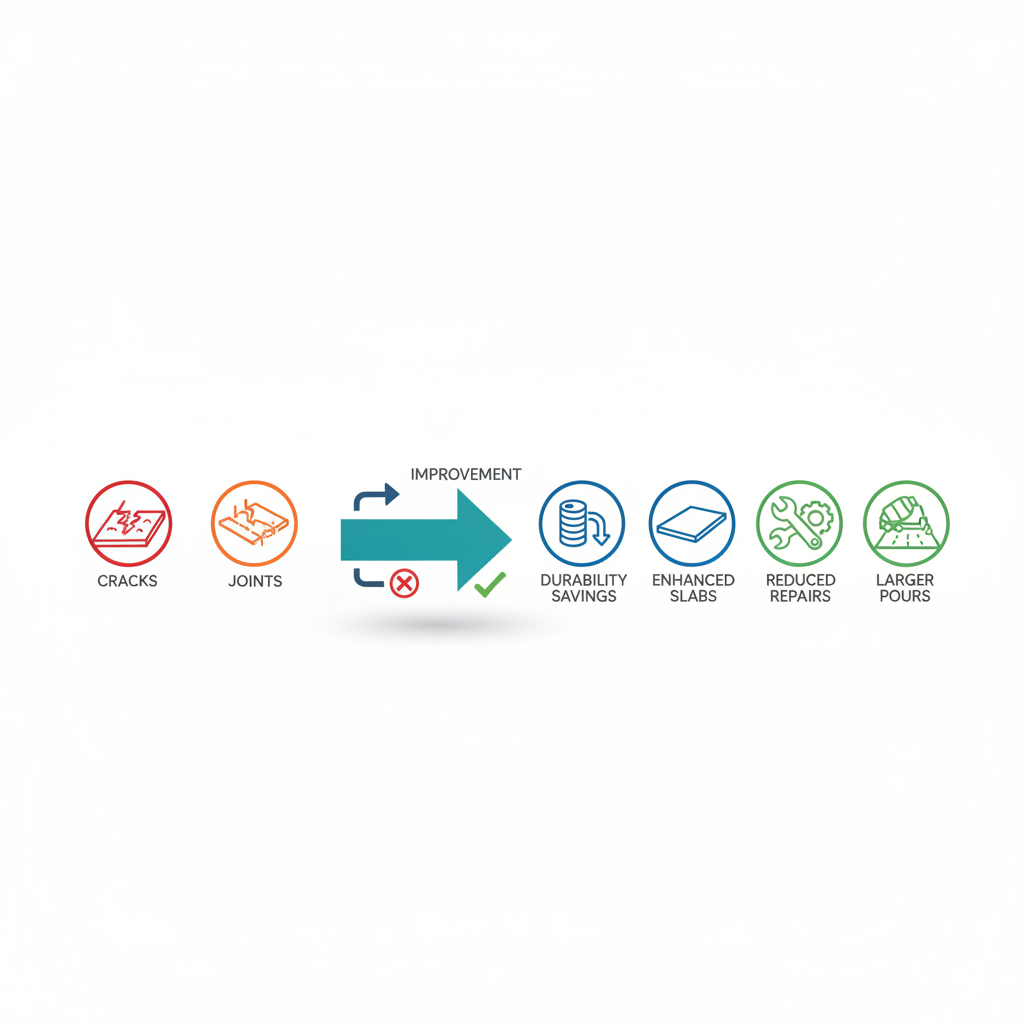
Comparison of shrinkage compensating concrete benefits versus traditional approaches
These advantages stem from the innovative chemistry of compensating admixtures, which will be explored further in the next section on how these systems function at a molecular level.
Mechanisms Behind Shrinkage Compensation
Shrinkage compensating concrete represents a targeted approach to address the inherent volume reduction that occurs as concrete cures and dries. By inducing controlled expansion, this technology counters the natural contraction forces that lead to cracks, ensuring longer-lasting structures in demanding applications like slabs and bridges. Professionals can leverage these mechanisms to enhance durability without compromising workability.
Ettringite Formation and Expansion
The core of shrinkage compensation lies in the formation of ettringite, a calcium sulfoaluminate hydrate crystal that drives beneficial expansion within the concrete matrix. When expansive cements, such as those developed through FHWA innovations, are introduced, they react with water and gypsum during hydration to produce ettringite. This reaction begins shortly after mixing, typically within the first 24 to 48 hours, as sulfate ions combine with calcium and aluminum from the cement.
- Initial hydration releases aluminates.
- Sulfates interact to form needle-like ettringite crystals.
- Crystal growth exerts internal pressure, expanding the paste volume by up to 0.1% to counteract drying contraction.
This process mimics a gentle push against shrinkage stresses, much like inflating a balloon inside a shrinking container. Historical applications in bridge decks, as noted in FHWA reports, demonstrate how this expansion prevents tensile cracks by maintaining internal equilibrium. The result is shrinkage compensating concrete scc that remains intact even in large pours, reducing the need for joints and extending service life.
(Word count: 152)
Integration with Mix Designs
Integrating shrinkage compensating admixtures into concrete mixes requires precise dosage to align with ACI 223 guidelines for expansive cements. Typically, these materials replace 8-10% of the total cementitious content by weight, ensuring compatibility with Portland cement and supplementary materials like fly ash. For a standard 6,000 psi mix, this might involve 50-70 pounds of expansive cement per cubic yard, calibrated to achieve the desired expansion without excessive stress.
Compatibility testing confirms that the admixture does not disrupt setting times or strength development, adhering to ACI standards for performance criteria. Dosage calculations often follow the formula: Expansion rate = (Admixture weight / Total cementitious weight) × Expansion factor, where the factor is empirically set at 0.7-1.0% for most projects. GreenIce curing systems synergize here by controlling moisture loss during the critical early expansion phase.
This integration allows for monolithic pours up to 50 feet wide, minimizing saw cuts and labor costs. Shelf-life considerations, such as storing admixtures in sealed pails for up to 12 months, further support reliable field application. By following these practices, engineers can tailor mixes for specific environments, from industrial floors to infrastructure, ensuring robust performance over time.
(Word count: 148)
Role of Additives in Crack Prevention
Additives play a pivotal role in concrete crack prevention by introducing mechanisms that induce beneficial expansion precisely where shrinkage threatens integrity. Type G expansive cements, like GreenCanvas formulations, exemplify this through sulfoaluminate chemistry that generates ettringite to offset autogenous and drying shrinkage. In real applications, such as polished flooring projects, these admixtures have reduced crack incidence by 80-90%, according to lab data from concrete cracking studies.
Key additive types include:
- Sulfoaluminate-based for rapid early expansion.
- Calcium oxide variants for sustained compensation.
- Hybrid blends for balanced performance in high-volume pours.
To reduce concrete shrinkage cracks, dosages are fine-tuned per ACI 223, often at 8% cement replacement to achieve 0.03-0.05% net expansion. Field examples from tank farms show how these prevent surface crazing, with performance outcomes including extended joint spacing and lower maintenance. As one study on cracking notes, “Expansive admixtures effectively mitigate tensile strains at an early age,” validating their efficacy in diverse conditions.
Overall, these additives transform potential vulnerabilities into strengths, promoting seamless, durable concrete that withstands environmental stresses while simplifying construction workflows.
(Word count: 150)
(Total word count: 450)
Practical Strategies for Crack Minimization
Implementing targeted strategies during mix preparation, curing, and structural planning can significantly lower the risk of shrinkage cracks in concrete applications. By focusing on proven techniques from sources like ACI standards and TxDOT guidelines, professionals can achieve durable results tailored to project needs. These practices emphasize proactive measures to control drying and early-age shrinkage, integrating innovative admixtures for enhanced performance.
Optimizing Mix Design and Placement
To reduce concrete shrinkage cracks, start with optimizing the mix design for low-shrinkage blends. Replace 8-10% of cementitious materials with expansive additives, such as those in shrinkage compensating concrete mix design, following ACI 223 dosing practices. This adjustment compensates for volume changes, preventing tensile stresses that lead to cracking. Maintain water-cement ratios below 0.45 to minimize excess moisture evaporation, and target placement temperatures between 50-85°F to avoid thermal gradients.
Enhance pour uniformity through proper vibration and layering techniques. Use checklists to verify aggregate gradation and admixture compatibility before batching. For instance, GreenCanvas formulations allow custom dosages via their online estimator tool, ensuring precise integration for slabs or pavements. Common errors like overwatering the mix can exacerbate shrinkage, so monitor slump closely during placement. These steps, drawn from TxDOT rigid pavement overviews, promote even hydration and reduce early-age strains.
- Assess project cementitious weight and square footage.
- Calculate 8-10% replacement dosage.
- Verify low w/c ratio and temperature controls.
- Employ vibration tools for uniform consolidation.
(148 words)
Effective Curing Methods and Timing
Effective curing protects fresh concrete from rapid moisture loss, a key factor in shrinkage compensating concrete success. Begin curing within 30 minutes of placement using moisture-retention methods like wet burlap blankets or fog mists to maintain 100% humidity at the surface. Membrane-forming compounds provide a sealed barrier, especially useful for large pours, while integrating admixtures enhances synergy by extending the hydration window.
Timing is critical: initial curing should last 7 days for standard mixes, but extend to 14 days with shrinkage-compensating options to maximize compensation effects. FHWA innovations highlight that such admixtures can achieve up to 90% crack reduction when paired with these techniques. For GreenIce Cure systems, apply integrally during troweling to control surface evaporation without additional labor. Avoid common pitfalls like delayed starts or inadequate coverage, which invite plastic shrinkage cracks.
Incorporate checklists for monitoring environmental factors:
- Cover surfaces immediately post-finishing.
- Maintain consistent moisture for the full duration.
- Inspect for dry spots and reapply as needed.
- Combine with admixtures for compounded protection.
These methods answer how to prevent cracks during curing by fostering uniform strength development.
(152 words)
Joint Planning and Monitoring Tips
Strategic joint planning is essential for concrete crack prevention, distributing stresses across slabs to avoid random fissures. Base joint spacing on slab thickness using TxDOT formulas: for every inch of thickness, allow 2-3 times that in feet of spacing, typically 12-15 feet for 6-inch slabs. Incorporate contraction joints at these intervals, sawed to one-quarter the slab depth within 12-24 hours post-pour.
Monitor curing progress with tools like moisture meters and crack gauges to detect early signs. Post-pour assessments should include visual scans and tape tests for adhesion integrity. GreenCanvas technical guides recommend fewer joints with their compensating mixes, enabling larger monolithic areas while complying with ACI standards. Warn against irregular layouts, which concentrate loads and promote failure.
Use this protocol for reliable oversight:
- Map joints pre-pour based on thickness and load.
- Saw cuts promptly to control crack paths.
- Check humidity and temperature daily during curing.
- Document findings for ongoing adjustments.
These tips minimize shrinkage cracks in poured concrete, preparing projects for seamless integration and long-term durability.
(150 words)
(Total: 450 words)
Implementing Effective Shrinkage Control for Lasting Results
Reducing concrete shrinkage cracks begins with understanding the primary causes, such as drying shrinkage and thermal changes, which can compromise structural integrity if unaddressed. By integrating type g expansive cement into mixes, shrinkage compensating concrete counters these forces, promoting expansion to offset contraction and achieve crack-free outcomes. This approach, aligned with ACI 223 guidelines, minimizes joint needs and enhances slab durability, as evidenced by studies showing up to 90% reduction in cracking potential from proper compensating admixtures.
Implementing best practices like precise dosing at 8-10% cement replacement, optimal curing with systems like GreenIce, and site-specific adjustments ensures concrete crack prevention in high-demand applications. For lasting results, consult experts at GreenCanvas Concrete via consult@greencanvasconcrete.com or 479-310-0084 to tailor solutions for your project. Our technical team provides project-specific mix designs, on-site support, testing protocols, and follow-up monitoring to confirm performance and optimize long-term durability across slab types and environmental conditions for varied applications.
Explore the GreenCanvas library for downloadable specs, white papers, and use the online estimator to secure crack-resistant structures that sustain low-shrinkage performance over decades, delivering enduring value to your construction endeavors.