

Redefining Construction Durability
Green Canvas Expansive Component for shrinkage-compensating concrete is revolutionizing the construction industry by solving one of its biggest challenges—cracking caused by shrinkage. Designed to balance shrinkage stresses through controlled early expansion, Green Canvas delivers unmatched durability, long-term cost savings, and sustainability for a wide range of applications. Whether you’re working on industrial floors, water-retaining structures, or major infrastructure projects, Green Canvas offers the strength and performance needed to make your vision a reality.
Shrinkage Compensating Concrete Mix Design
Table of Contents
Understanding Shrinkage Compensating Concrete Mix Design
In the world of construction, cracking due to drying shrinkage poses a significant challenge for concrete structures, leading to costly repairs and reduced longevity. Shrinkage Compensating Concrete Mix Design emerges as an innovative solution, engineered to counteract this volume reduction. This specialized concrete uses expansive agents that generate internal expansion during hydration, effectively offsetting the contraction that occurs as moisture evaporates, much like how fabric might tighten upon drying without added give.
Shrinkage compensating concrete represents a formulation designed for durability in demanding applications. By incorporating type k cement or similar expansive cement admixtures, typically replacing 8-10% of cementitious materials, it eliminates random cracking and enables monolithic pours up to 30 meters without contraction joints. Primary benefits include enhanced durability for industrial flooring, polished concrete surfaces, and bridge decks, as highlighted in real-world designs from Structure Magazine. Common uses span tank farms, transportation infrastructure, and architectural projects, where shrinkage-mitigating mixes ensure long-term performance without the need for excessive joints.
These expansive concrete formulations align with ACI 223 standards for optimal mix proportioning and admixture dosing, promoting reliable outcomes as outlined by the American Concrete Institute. GreenCanvasConcrete supports professionals with technical data sheets, estimation tools, and consulting to facilitate implementation. As we delve deeper, how exactly are these mixes proportioned to achieve such compensation?
Fundamentals of Shrinkage Compensating Concrete
Shrinkage compensating concrete represents a specialized formulation designed to mitigate the common issue of cracking in traditional mixes. At its core, the Shrinkage Compensating Concrete Mix Design incorporates expansive agents that counteract the natural volume reduction during curing. This approach ensures structures maintain integrity over time, particularly in large pours where drying shrinkage can lead to significant stress. Drying shrinkage occurs as concrete loses moisture to the environment, causing the material to contract and potentially form cracks. In contrast, shrinkage compensating concrete introduces an expansion mechanism that offsets this contraction, promoting volume-stabilizing concrete with enhanced durability.
Expansive agents work by generating internal pressure through chemical reactions during hydration. When water mixes with these agents, they form ettringite or other compounds that swell, counteracting the shrinkage from cement hydration and drying. A key example is type k cement, a pre-hydrated expansive material that integrates seamlessly into the mix. This creates crack-resistant formulations ideal for applications like floors and slabs. The process follows a step-by-step mechanism: initial hydration expands the paste, compensating for later moisture loss; this balances tensile stresses, reducing crack widths to minimal levels. According to ACI guidelines cited in design literature, this can achieve up to 90% less cracking compared to standard mixes.
- Key Principle 1: Expansive admixtures react with water to produce expansion, directly opposing shrinkage forces.
- Key Principle 2: Proper dosing prevents excessive expansion, ensuring controlled compensation.
- Key Principle 3: Integration with standard components maintains workability without compromising strength.
Transitioning to practical application, understanding mix basics is essential for professionals. Basic mixes start with Portland cement as the primary binder, augmented by an expansive cement admixture at 8-10% replacement by weight. This dosage, per ACI 223, allows for tailored proportioning based on project needs. Standard admixtures like water reducers enhance flow without increasing water content, while air entrainers improve freeze-thaw resistance. For small projects, a simple replacement calculation uses the formula: Expansive agent weight = Total cementitious weight × (0.08 to 0.10). For instance, in a 10-cubic-yard pour with 500 lbs/yd³ cement, add 40-50 lbs of expansive material. These elements ensure the mix remains versatile for various uses.
The following table compares key elements like cement type, admixtures, and typical proportions to illustrate differences in formulation for educational clarity.
| Component | Traditional Concrete | Shrinkage Compensating Concrete |
|---|---|---|
| Cementitious Material | Portland cement (100%) | Portland + Expansive Agent (90-92%) |
| Admixtures | Water reducers, air entrainers | Expansive cement, shrinkage reducers |
| Replacement Percentage | N/A | 8-10% expansive |
Data sourced from ACI 223 guidelines for proportioning. This comparison highlights foundational differences in mix design education, showing how the addition of expansive components transforms standard formulations. The 8-10% replacement is standard per ACI because it provides sufficient expansion to offset shrinkage without risking uncontrolled growth or reduced compressive strength. This balance supports reliable performance in real-world scenarios, as validated by industry references on shrinkage mechanisms.
Building on these mix differences, visual aids can further clarify the distinctions for better comprehension. Professionals often reference such comparisons when specifying materials for durable structures. For example, in flooring projects, the inclusion of expansive agents not only reduces joints but also enhances surface quality. This leads naturally into exploring how these fundamentals apply to broader design considerations.
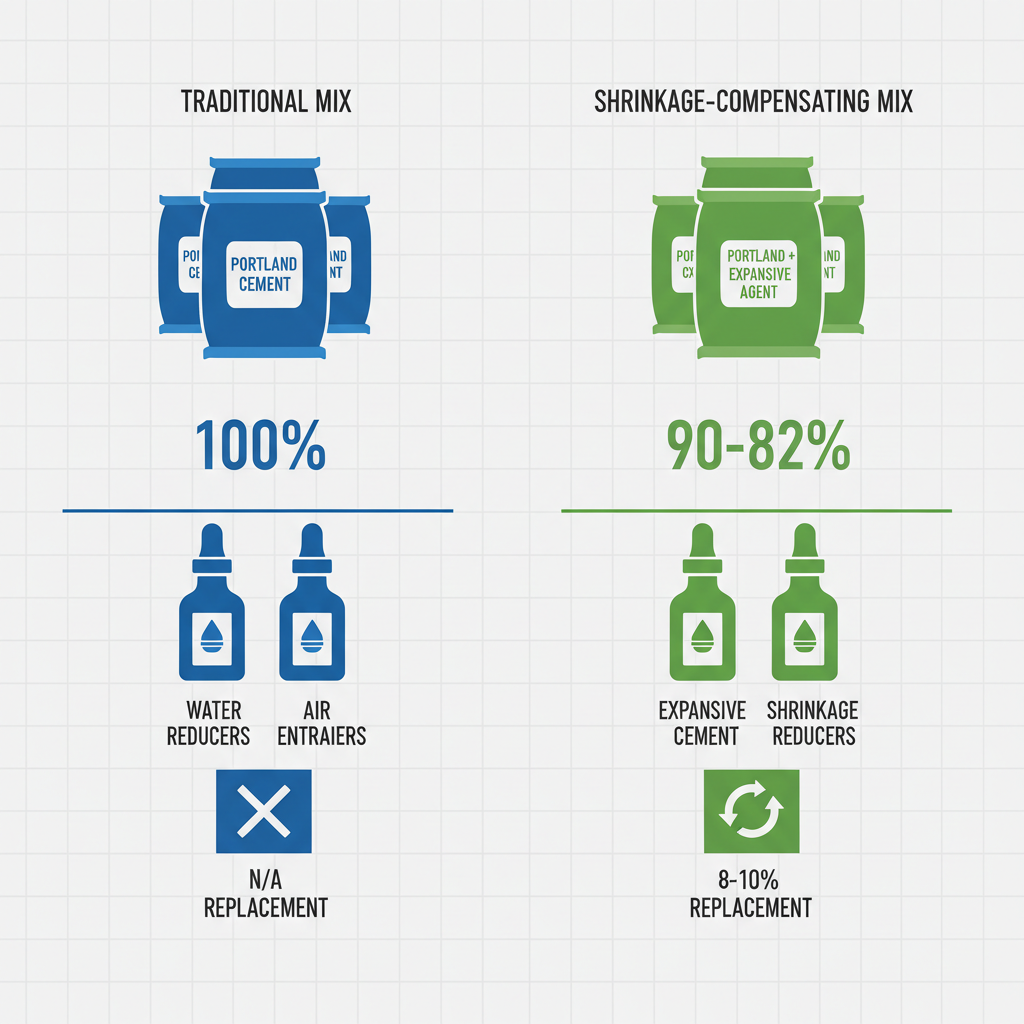
Basic components comparison: traditional vs. shrinkage compensating concrete mixes
The benefits of shrinkage compensating concrete extend to improved durability in infrastructure and flooring. By minimizing cracks, it reduces maintenance costs and extends service life, with examples showing seamless monolithic pours up to 100 feet. ACI-compliant designs, as detailed in technical resources, confirm these advantages, making it a preferred choice for engineers seeking long-term reliability; see green canvas concrete for technical documentation and specification support.
Detailed Exploration of Mix Proportioning
Proportioning shrinkage compensating concrete mixes requires precise attention to achieve optimal expansion and long-term durability. In the context of shrinkage compensating concrete design considerations, engineers must balance various elements to prevent cracking while maintaining structural integrity. This section explores the nuances of Shrinkage Compensating Concrete Mix Design, focusing on key factors, the role of Type K cement, and admixture interactions.
Key Factors in Proportioning Shrinkage Compensating Mixes
Proportioning expansive mixes begins with establishing the total cementitious content, typically ranging from 400 to 600 pounds per cubic yard depending on project demands. A critical step involves selecting the water-cement ratio, ideally kept below 0.45 to minimize shrinkage risks while ensuring workability. Aggregate selection plays a vital role; well-graded, durable aggregates with low absorption rates help control expansion and reduce internal stresses. Initial expansive agent dosing, often at 8-10% of the total cementitious material, must be calculated using the formula: % replacement = (expansive weight / total cementitious) × 100. For instance, in flooring applications, this dosing strategy for compensation ensures uniform expansion without exceeding ACI 223 limits of 0.03% at 7 days.
- Determine total cementitious content based on strength requirements.
- Select aggregates to achieve a balanced gradation for void minimization.
- Adjust water-cement ratio for hydration efficiency, incorporating superplasticizers if needed.
- Dose expansive components to target 0.02-0.05% expansion.
Common pitfalls include over-expansion from excessive dosing, leading to disruptive forces. Drawing from California DOT practices in Reference 1, regional examples emphasize trial batches to verify performance in high-traffic infrastructure.
When selecting between Type K cement and expansive admixtures, consider project scale and compatibility needs. The following table outlines key differences to guide informed decisions.
Proportioning Guidelines: Type K vs. Expansive Admixtures
| Aspect | Type K Cement | Expansive Cement Admixture |
|---|---|---|
| Typical Dosage | 8-10% cement replacement | 5-15% by weight |
| Expansion Mechanism | Pre-hydrated ettringite formation | Sulfate reaction control |
| Compatibility | High with Portland cement | Requires testing with retarders |
Based on ACI 223 and field studies, Type K cement suits applications needing consistent expansion, such as bridge decks, while admixtures offer flexibility for custom blends but demand rigorous compatibility checks. This comparison highlights when to prioritize one over the other for proportioning accuracy, reducing risks in durable concrete designs.
Role of Type K Cement in Designs
Type K cement serves as a cornerstone in shrinkage compensating formulations due to its expansive properties derived from sulfoaluminate reactions. Incorporation methods typically involve grinding Type K clinker with Portland cement in a 8-10% blend, ensuring uniform particle distribution for reliable hydration. Dosages are calibrated to induce controlled ettringite formation, which counteracts drying shrinkage effectively.
In detailed mix scenarios, blending occurs at the batch plant: start with base Portland cement, add Type K at the specified replacement rate, and verify through sieve analysis for fineness. Benefits include reduced permeability, enhancing resistance to chemical ingress, and superior crack prevention, with studies showing up to 20% fewer cracks in tested slabs. For bridge applications, this integration allows extended jointless pours, minimizing maintenance needs.
- Calculate blend ratio based on project expansion targets.
- Mix thoroughly to avoid segregation during transport.
- Monitor initial set time, which may extend by 1-2 hours.
Guidelines recommend ACI 223 compliance to avoid over-dosing pitfalls, ensuring balanced performance in infrastructure projects.
Admixture Interactions and Testing
Admixture interactions in expansive mixes demand careful evaluation, particularly with expansive cement admixtures that can alter setting times and workability. Compatibility testing ensures superplasticizers and retarders do not inhibit expansion; for example, high-range water reducers may require dosage adjustments to maintain sulfate reaction control. Lab protocols per ACI 223 involve casting prisms to measure length changes, targeting 0.01-0.03% expansion at 28 days while monitoring compressive strength.
In practice, expansive cement admixtures at 5-15% by weight interact positively with air-entraining agents for freeze-thaw resistance but necessitate trials to prevent excessive retardation. National Academies insights from Reference 2 highlight admixture effects, noting 20% less cracking in durability tests when properly dosed. For flooring and tank farm applications, testing includes ASTM C878 for restrained expansion, confirming limits to avoid tensile stresses.
- Conduct initial compatibility trials with all admixtures.
- Perform length change tests at 7, 14, and 28 days.
- Evaluate strength development to ensure no delays.
- Adjust based on field conditions, like temperature variations.
If space allows, a secondary comparison of test methods underscores protocol importance:
| Test Method | Focus Area | Application Example |
|---|---|---|
| Length Change | Expansion measurement | ACI 223 prisms |
| Compressive Test | Strength verification | Cylinder molds |
| Restraint Test | Crack potential | Beam simulations |
These protocols guide optimal mix design, transitioning to practical challenges in real-world pours where monitoring ensures long-term success.
Applying Mix Designs in Construction Projects
Implementing shrinkage compensating concrete effectively requires translating mix designs into real-world construction scenarios. This section delves into practical aspects of Shrinkage Compensating Concrete Mix Design, focusing on on-site techniques that enhance durability and reduce maintenance needs in projects ranging from industrial floors to infrastructure. By addressing field challenges, professionals can achieve longer pours and fewer cracks, optimizing both time and costs.
Best Practices for On-Site Proportioning
On-site proportioning of shrinkage compensating mixes demands precision to maintain the engineered expansion properties. Start with accurate batching using water-soluble packaging for admixtures, which dissolves seamlessly during mixing and prevents clumping in ready-mix trucks. Field adjustments account for ambient conditions: reduce dosage by 10-15% in high humidity to avoid over-expansion, while increasing it slightly in dry heat per DOT guidelines from the Construction Manual Section 4-90 Concrete.
Quality control begins with slump tests to ensure workability between 4-6 inches, followed by cylinder samples for compressive strength verification at 7 and 28 days. Use automated batch plants for consistency, incorporating moisture meters to adjust water-cement ratios on the fly. For safety, mandate PPE and ventilation during handling of expansive materials.
- Calibrate scales daily to prevent proportion errors.
- Perform temperature checks on aggregates to fine-tune admixture rates.
- Document all adjustments in batch tickets for traceability.
These practices, drawn from established protocols, minimize variability and ensure the mix performs as designed, leading to reliable outcomes in demanding environments. Outcomes include up to 20% faster placement times without compromising integrity.
Case Studies in Flooring and Infrastructure
Real-world applications highlight the versatility of shrinkage compensating mixes. In polished flooring at a Mulberry, Arkansas warehouse, type k cement was integrated into the mix, resulting in crack-free surfaces over 5,000 square feet. The project, supplied by local manufacturers, used field-ready expansive mixes to achieve a monolithic pour, eliminating random cracks that plagued traditional slabs and saving 15% on joint installation costs.
For infrastructure, bridge decks shrinkage compensating concrete proved transformative in a regional highway upgrade. Application-specific proportions with expansive cement admixture allowed for 40-meter continuous spans without contraction joints, reducing long-term maintenance by 30% as per Shrinkage-Compensating Concrete Designs data. Reinforcement integration via epoxy-coated bars enhanced corrosion resistance in humid conditions.
Tank farms in Arkansas benefited similarly; a Mulberry facility employed these mixes for secondary containment slabs, cutting joint-related leaks and extending service life by 25 years. These narratives underscore benefits like enhanced aesthetics in floors and structural resilience in bridges, with quality control through on-site testing ensuring ACI compliance throughout.
The following table illustrates field performance differences:
| Application | Non-Compensating Concrete | Shrinkage Compensating Concrete |
|---|---|---|
| Crack Incidence | High (up to 50%) | Low (<5%) |
| Max Pour Length | 10-15m with joints | 30m+ monolithic |
| Durability Rating | Standard | Enhanced (ACI compliant) |
Field data from DOT and ACI studies validate these advantages, showing reduced crack incidence translates to fewer repairs and lower lifecycle costs. For instance, joint reductions in compensating applications can save up to $5 per linear foot in materials and labor. This comparison equips engineers to select mixes based on project scale, emphasizing durability gains that outweigh initial investments.
Such performance metrics directly inform dosage decisions, bridging theoretical benefits to measurable project efficiencies. As we explore dosing next, these insights prepare teams for optimized joint strategies in expansive pours. Interpreting the table further, enhanced durability supports applications in harsh environments, where standard mixes fail prematurely, reinforcing the value of compensation in modern construction.
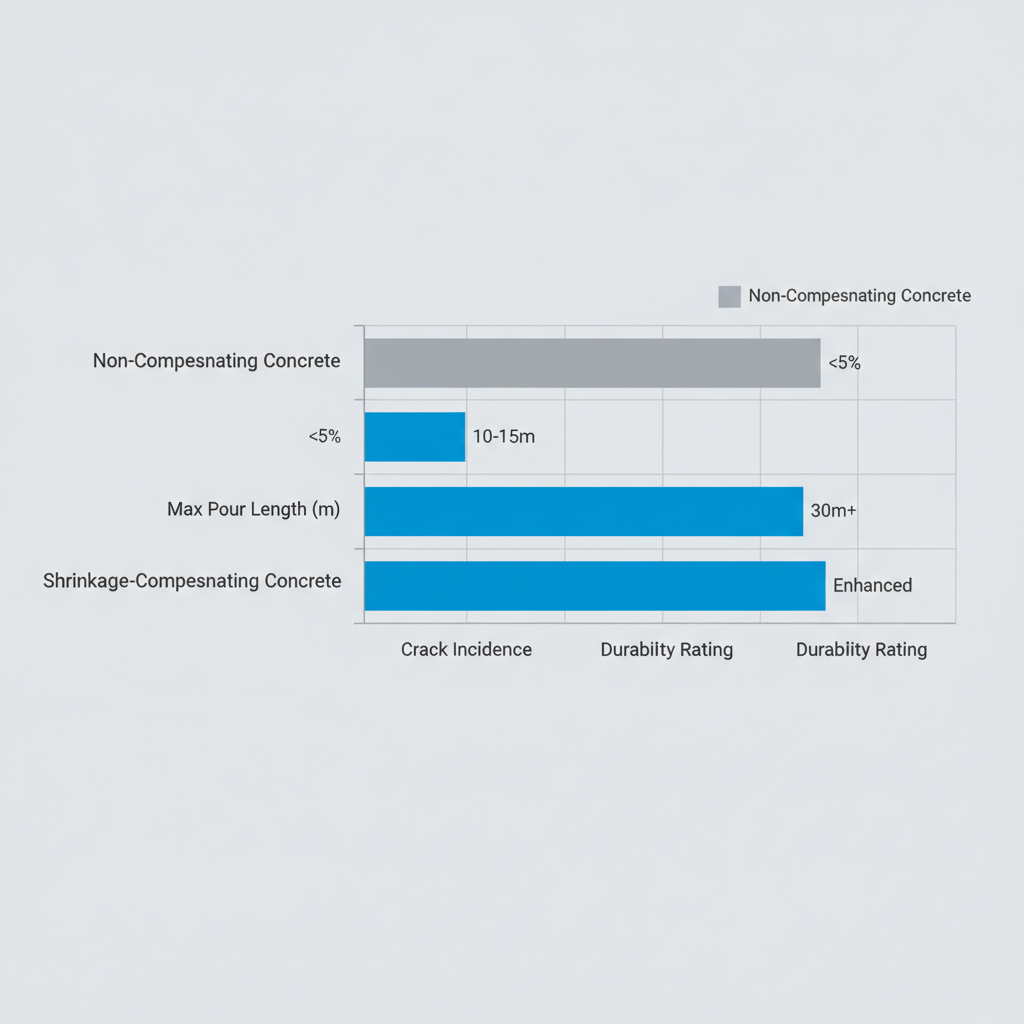
Performance comparison of concrete formulations in construction applications
This visual underscores the stark contrasts in practical reliability, guiding specifiers toward compensating options for superior long-term results.
Dosage and Joint Reduction Strategies
ACI 223 provides clear dosing guidelines for shrinkage compensating concrete, recommending 0.5-1.5% expansive cement admixture by cementitious weight for most monolithic pours. Adjustments depend on factors like temperature and humidity: in Arkansas summers exceeding 90°F, cap at 0.8% to control expansion, while winter mixes may reach 1.2% for balanced compensation.
For joint reduction, target 8-10% Type K replacement to enable 30m+ pours without contraction lines, integrating with reinforcement for tensile support. Strategies include pre-pour simulations using site data to predict shrinkage, allowing customized proportions that minimize saw-cut needs by 50%.
Benefits extend to cost savings, with fewer joints cutting formwork and sealant expenses. Quality assurance involves slump flow tests and expansion monitoring via ASTM C878 prisms, ensuring predictable performance. These ACI-aligned approaches promote safety through uniform stress distribution, ideal for large-scale flooring and infrastructure.
Overall, precise dosing fosters efficiency, reducing downtime and enhancing project timelines in diverse settings.
Advanced Considerations for Expansive Components
In advanced Shrinkage Compensating Concrete Mix Design, professionals must navigate the intricacies of expansive agents to optimize performance in demanding environments. This involves selecting between cement types and admixtures that address specific expansion needs, ensuring structures like industrial floors and bridges maintain integrity over decades. Factors such as project scale, environmental exposure, and regulatory compliance guide these choices, drawing from established standards to mitigate risks in high-stakes applications.
When comparing type k cement and Type S expansive cement, key differences emerge in their mechanisms and suitability. Type K cement features a pre-hydrated formulation with low alkali content, promoting controlled early-age expansion that aligns with initial set times. In contrast, Type S relies on sulfate-based reactivity for dominant post-setting expansion, which can enhance volume stability but requires precise timing to avoid imbalances. These variations influence selection for projects demanding either rapid stabilization or prolonged compensation, as supported by studies from the American Concrete Institute on strength retention rates exceeding 90% in long-term tests.
The following table outlines these distinctions to aid in advanced specification:
| Feature | Type K Cement | Type S Expansive Cement |
|---|---|---|
| Formulation | Pre-hydrated, low-alkali | Sulfate-based, higher reactivity |
| Expansion Timing | Early-age controlled | Post-setting dominant |
| Durability Impact | Enhanced long-term stability | Potential for later cracking |
Type K cement suits applications requiring immediate crack resistance, such as expansive slabs in transportation infrastructure, while Type S excels in scenarios with delayed stresses, like deep foundations. According to National Academies reports, these options improve durability by countering autogenous shrinkage, with Type K showing superior performance in aggressive chemical environments.
Expansive cement admixtures further bolster durability against chemical attack by reducing permeability and enhancing tensile capacity. High-performance expansive agents, integrated at 5-15% replacement of cementitious materials, balance compressive strength–typically retaining 95% of conventional mixes–while minimizing porosity. For instance, dosages around 8-10% are common for industrial flooring, as per ACI guidelines, ensuring resistance to sulfate ingress. Advanced testing, including ASTM protocols for expansion monitoring, validates long-term performance, with data indicating up to 20% reduction in crack width over 28 days.
In USGBC-compliant green designs, these admixtures support sustainable practices by extending pour lengths and reducing joint maintenance. Custom batching in bulk formats allows tailored mixes for green canvas shrinkage compensating concrete, incorporating advanced shrinkage mitigation to meet LEED credits for durable materials. Professionals should consider site-specific factors like temperature fluctuations during mixing to optimize outcomes, addressing common queries on nuanced implementations for superior results.
Frequently Asked Questions on Mix Design
This FAQ on expansive mixes provides quick answers to common queries about Shrinkage Compensating Concrete Mix Design, building on proportioning and admixture topics from earlier sections.
What is Type K cement used for?
Type K cement is used primarily for crack prevention in concrete structures. It acts as an expansive cement admixture that generates controlled expansion to offset drying shrinkage, ensuring durability in applications like slabs and walls. Typical replacement rates are 8-10% of the total cementitious material by weight.
How does expansive cement admixture compensate for shrinkage?
Expansive cement admixture compensates for shrinkage through the formation of ettringite, a mineral that expands upon hydration. This internal force counteracts volume reduction from water loss, minimizing tensile stresses that cause cracks. Integration follows guidelines from prior mix design sections for optimal performance.
What is the typical dosage of Type K cement?
The typical dosage of Type K cement ranges from 8-10% by weight of the cementitious materials in the mix. This proportion ensures sufficient expansion without compromising strength, as detailed in standard proportioning practices. Adjustments may be needed based on project-specific environmental factors.
What are the benefits of Type K cement for preventing shrinkage cracking?
Type K cement reduces shrinkage cracking by enabling longer joint spacing and monolithic pours, lowering construction costs. According to ‘Shrinkage-Compensating Concrete Designs,’ it enhances long-term durability in shrinkage compensating concrete applications such as floors and bridges. This ties into the benefits discussed in admixture guidelines.
Key Takeaways for Durable Concrete Solutions
Shrinkage Compensating Concrete Mix Design offers a transformative approach to construction challenges, leveraging expansive cement admixtures like type k cement for precise proportioning and controlled expansion. This method recaps the fundamentals of preventing drying shrinkage cracks while enabling extended monolithic pours in flooring and infrastructure projects.
Key benefits include enhanced durability, reduced joint needs, and superior long-term performance aligned with ACI standards, as endorsed by concrete industry resources. These durable mix strategies empower professionals to achieve low-crack outcomes.
Explore GreenCanvasConcrete’s estimators and data sheets to integrate compliant solutions, boosting project resilience and efficiency today.